Showing posts with label Let's Talk About Sex. Show all posts

Wednesday, May 8, 2013

Let's Talk About Sex (Baby)


           Throughout this course, as a class we’ve read various poems and novels that center around women. These contexts can range from adoration, to love, to frustration and the need for dominance. In most cases, the context of the work is seen through a predominantly heterosexual male gaze. Taking these works and their perceived male gaze into account, I plan to conceive an understanding as to how each shaped the concept of female sexuality. I will direct most of my attention to The Bloody Chamber, The Strange Case of Dr. Jekyll and Mr. Hyde, and Goblin Market and how each author treats sexuality in regard to women. I will also reference The Lady of Shalott, My Last Duchess, Romance of the Forest, and La Belle Dame sans merci and their treatment of female subjugation and the use of “feminine wiles.” 

                Carter’s The Bloody Chamber treats the protagonist of the story as virginal and naïve in the first few pages. She is newly married to a thrice widowed nobleman who wooed her with extravagant gifts and overtures. The reader joins her as she learns her way about her husband’s household and discovers his morbid fascination with pornographic art, literature, and life style. His language toward his new bride centers upon his domination of her person, referring to her as “little love,” “little nun,” and “baby.” His pet names obviously demean his wife (who should be his equal in a modern context) into the role of a child, and a petulant one at that. Her casual perusal of his library and various works of art represent her ongoing corruption and eventual loss of innocence (i.e. her “maidenhood”). Using the 50 Shades of Bloody Chamber post as a starting point, I concluded that Carter’s tactic of using fairy tales to prove her point simply enhanced the territorial nature of the Marquis by portraying him with lupine features, harkening to the domineering Big Bad Wolf. The unnamed narrator’s eventual discovery of the bloody chamber represents the perils of being a passive victim in sexual relationships. This is mirrored and foreshadowed by “the girl with tears hanging on her cheeks like stick pearls,” depicted in her husband’s copy of the Robs illustrations. 

Robs 'The Greatest Love of Don Juan'


                Rossetti’s Goblin Market deals with the companionship of women and overt homoerotic themes. Laura chooses to eat the goblin’s fruits and suffers greatly for it, whereas her sister Lizzie vows to cure Laura. She accomplishes this by returning to the market and goading the goblins into pelting her with their wares; she returns to Laura with the juices dripping from her skin which her sister greedily sucks and lick off her skin. This can be read in various ways: purity versus fallen-ness and sin being atoned for by repentance and achieving a new “virtue.” I contrast Rossetti’s themes with those of Stevenson’s in The Strange Case of Dr. Jekyll and Mr. Hyde. In this work there is not one major female character, and the key players remain bachelors. The scene I will focus on is Hyde’s trampling of the young girl. He pays off the family and in doing so creates a strange gender shift by seemingly prostituting himself. Considered a lowly profession in Victorian times, women were typically prostitutes and suffered from a slew of sexually transmitted diseases. With the lack of wives in the novel, it appears that Jekyll represses his desire for female company and intimacy whereas Hyde, being his polar opposite, would not. Hyde is the absence of morality and therefore has the freedom and canonical backing to pursue sexual pleasure with his dominant nature.  

                Radcliffe takes a different approach in Romance of the Forest by choosing the slowly build her heroine’s character. Adeline at first glance comes off as more of a wet noodle than a true heroine and it is only through further reading that the audience discovers her sly wit and calculating mind; which has been cleverly concealed behind her ‘damsel in distress’ façade. Adeline, and women and general, are expected to claim their identity, according the Cynthia Griffin Wolff’s essay The Radcliffean Gothic Novel: A Form for Feminine Sexuality. Wolff elaborates saying that a woman’s agency hinges upon choosing one of two loves: the “chaste” non-aggressive love, or the “demon” love which is meant to be a reflection upon her own sexual aggression and fantasies (103). Her own “entrance into society” and reputation urges the heroine to choose the chaste love, and in turn repress her own sexual urges deemed “unfit” by society. Adeline does this in the novel by choosing Theodore, her only viable option for escape; in turn making him the “chaste” option and furthermore Mr. Right. 

                In My Last Duchess, clearly “demon” won out and ended in the eventual death of the girl in the portrait. She has been reduced to an object of beauty, as opposed to a living and breathing human being, which unfortunately has been prevalent throughout the ages. This poem sparked my curiosity into investigating the perception of women in the eyes of the artist. The concept of beauty shifted throughout the Victorian era and those changes can be seen through several works of art; the imitation of sunlight upon the neck or collarbone, heightened color in the cheeks, fabrics being depicted in swelling and swaying forms, etc. “women are reduced to an aesthetic arrangement of sexual parts, for male fantasies." This objectifying women and dismantling them for parts can be readily seen in our own modern advertising; it’s considered rare to see an ad of a whole woman in an advert directed to sell men on a product. In the poem, the dismantling of the last duchess doesn’t do this far but there are hints of it. The Duke has his favorite parts of his late wife, but they were not aspects that of her personality that gave her character. Instead he despised her inquisitive nature, her quick to laugh kindness, and deemed the things she adored “childish.”
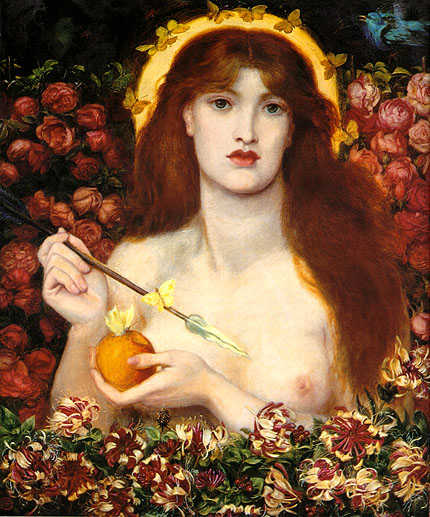
Dante Rossetti's 'Venus Verticordia'


                How does this aid comprehension of female sexuality? Aside from the fact that very few authors were women, men barely acknowledged female sexual desires; and when they did it was generally in regard to a fallen woman, prostitute, or voluptuary. That doesn’t exactly allow women to take the reins in their own sexuality, which encompasses their consent, fantasies, wants, and needs. The Victorian era was a very confusing time to be a woman; how and when were they to know their value? Was it when they chose the chaste love, or when their clothes were hitting the floor to pose for a painting? The dichotomy of the era kills me, which I believe is due in part to women’s shifting place in society. With the industrialization of England, middle class women were now able to work in factories for a salary. This differed from more home-spun ways of making a living, in which a woman would sit at a loom and weave, or sew. The Lady of Shalott describes the shift well, the Lady herself has no impetus to do anything other than sit at a loom and weave tapestries all day. That is until she sees Lancelot riding toward Camelot, in that moment her curse is thrust upon her. In a feminist view, the Lady’s curse concerns women’s issues with their place in society and their sexuality. 

              Obviously, women’s subjugation played a huge role in their institutionalization and the advent of “widow’s disease” or hysteria. Hysteria bloomed and was considered by medical professionals to be strictly a feminine issue (etymologically speaking, the Greek hysteria literally means her illness deriving from the word for uterus). Treatment for hysteria ranged from the invention of the vibrator to high powered “water massages” aimed at the vagina. It was first thought of as “wandering womb syndrome” and resulted in “female semen” needing to be expelled from the womb with regular climax and intercourse. But at the same time, women were supposed to be the “angel of the house” and in charge of the hearth, home and rearing of children. Clearly, the Victorian era is a far cry from our enlightened age of, “I want a lady in the street, but a freak in the sheets.”

                There is no resolution to be found within Victorian literature, no defined women’s lib movement empowering vaginas and sexual appetites everywhere. The same problem these women were facing still persists today, although in differing ways. Looking at it in black and white, sexuality is a fluid and ever changing force and most people fail to comprehend the affect it has on their person. It is in my belief that to truly understand our own sexuality (whoa there, I’m speaking as a fellow lady now) men must first attempt to understand their own. Which clearly they were not ready to do in the Victorian era! There was far too much riding on social propriety and reputation for them to even consider the prospect that their wives might have sexual desires of their own or that marrying someone does not make them your property. In closing, the various works, paintings, and essays discussed helped me to analyze and synthesize the greater theme of women’s sexuality in varying types of media. 

Bibliography:


Wolff, Cynthia Griffin. “The Radcliffean Gothic Novel: A Form for Feminine Sexuality.”Eighteenth Century Literature. 9:3 (1979): 98-113. Online: Proquest. May 1 2013.

 Lee, Elizabeth. "The Femme Fatale As Object." The Victorian Web. (1997). Online. Victorianweb. May 3 2013.


Wednesday, May 1, 2013

50 Shades of Bloody Chamber

Angela Carter's "The Bloody Carter" is a very dark story based off the tale of Bluebeard, in which Bluebeard stores the bodies of his previous wives in a chamber. Carter's story also makes a lot of references to tales and legends such as King Mark, Dracula, Tristan and Isolde, and Red Riding Hood ("All the better to see you.") These references as well as the many others gives the reader an idea of the atmosphere the main character is in. It's dark and sinister and deals with a passionate 'love' which is really just an obsession. It also gives the reader an idea about how young and naive the new bride is.

The choker made of rubies is a fascinating symbol of the story because it represents wealth, extravagance, ownership, humiliation, and even survival. It represents survival because the girl tells the story of how people who escaped execution during the Reign of Terror would tie red ribbons around their necks. This is very appropriate for the girl considering she herself is almost beheaded. She overcame her sadistic Big Bad Wolf much in the way her own mother conquered her would-be victimizers. (the mother even shoots him much like in certain versions of Little Red Riding Hood.)

Thursday, April 11, 2013

(Il)logic and (Non)sense

When reading Alice in Wonderland and The Importance of Being Earnest, I couldn't help but notice the authors differing uses of logic and sense. As in, they concocted their tales with the exact opposite: illogic and nonsense. Understandably, the Victorian audience was not expecting such convoloted uses of rhetoric, so for the vast majority of the audience, they failed to comprehend that the authors were in fact, making fun of their lifestyles. In Carroll's experience, even good old Queen Vic failed to grasp that he was challenging the monarchy and its indiscretion by making of light it, as exemplified by the Queen of Hearts. Wilde, however, chose to dissect society in general; this included the marriage market, gender, homosexuality, the education system, etc.

Carroll uses nonsense to enhance the reader's understanding of common sense, as opposed to what the government deems sensical (i.e., the trial scene in the novel). He uses Alice  to guide his reader's through the novel with their various prejudices while ever so slowly dismantling them. Wilde uses his characters (in all their exaggerations) as various archetypes for his audience to sympathize with. Their various turns of character and their snap decisions cause the audience to peer into a mirror of themselves. Whether they choose to recognize this, or not is completely up to their discretion.

Wednesday, April 3, 2013

A forsaken love

Matthew Arnold's Forsaken Merman has a lot going on. It reminds me of an ocean itself. On the surface there's a story of a merman falling in love with a human woman and her birthing his children then leaving him on Easter. What?? But if you look deeper you see the confliction between love and religion. The merman becomes increasingly depressing as the poem goes on yet still loves this woman. She, on the other hand, doesn't quite reveal her motives as to why she leaves the land for a merman and then decides to return due to hearing the church bells. Was religion that important to her? Or did she never love him at all? Or maybe the sea was too much of a difference from the civilization on land? All of these questions played in my head. Another thing that struck me was the influence of music in this poem. The children's voices, the Murmansk repetition of down, down, down and dear children and the church bells are all very influential to the melancholy atmosphere the poem draws on.

Monday, April 1, 2013

Deeper into the Goblin Market

I enjoyed reading Goblin Market by Christina Rossetti, but I felt my first reading was too straightforward. I saw the poem as strictly allegorical with strong Christian themes, as it almost seems a reenactment of the scene with Adam and Eve in the Garden of Eden. With its heavy description and deep narrative, I found it a strong allegory, but I wanted to learn about some other reading perspectives to delve deeper into the richness of the poem. When searching for other interpretations of Goblin Market, I came across a helpful article on Poetry Foundation that provided a few different readings, such as the psychoanalytic interpretations of the poem’s sexual elements and the Marxist criticism of separation of domestic and commercial spheres. If anyone is interested in reading these, you can find them embedded in this biography: http://www.poetryfoundation.org/bio/christina-rossetti

Wednesday, March 27, 2013

Dismantling the Patriarchy sans merci


After reading both versions of Keats' work, I find that I prefer the draft version over his published one. 'Knight-at-arms' just strikes a chord better than 'wight'. Plus, I find that the imagery comes easier in the first version of the poem. Incorporating the titles, 'sans merci' means without pity whereas 'sans mercy' is simply without mercy. Both phrases are ripe with meaning, but 'without pity' just appeals to me greater than 'without mercy'. In the draft, Keats has the knight-at-arms making the woman a flower crown, bracelets, and a zone before he is consumed by her power; it's his attempt to quell a wild woman and confine her to fit his needs within the patriarchy. Historically, the Victorian era bound women both by its social propriety and its fashions. I like that this woman with 'wild eyes', is still able to entrance a seemingly misogynistic man after his attempts to ensnare her.  It shows her command of faculties and refusal to give up her personal power, or agency. I find it both captivating and terrifying, but in the best sort of way; as if I too, are under this faery queen's spell. It reminds me of my favorite archetype in literature: disciples that love their god too much. For there is nothing crueler than being loved by something divine made flesh and blood.

Duke, you silver tongued devil you

"... Oh sir, she smiled, no doubt,
Whene’er I passed her; but who passed without
Much the same smile? This grew; I gave commands;
Then all smiles stopped together..."

I found Robert Browning's "My Last Duchess" to be an enticing poem, as it engages its readers on a number of levels - on a psychological and historical level among many. Quite noticeably on a psychological level because we only get the duke's thoughts. We have to piece together the story ourselves. The author forces its readers to become involved with the poem, so we can get a clear understanding of it, which makes it all the more fun.

The most fascinating element of the poem is the duke character, who is also the speaker. He lures his readers with his charming qualities and wonderful use of language. However, he has a monstrous side and an excessive demand for control. The biggest example of this is when duke has his wife murdered because she couldn't save her flirtatious glances for the him. "... I gave commands; then all smiles stopped together..." This is an interesting choice of words to describe the death of the duchess. It's not quite as dark as one expect it would be. It's as if the duke is trying to avoid the truth.


Tuesday, March 19, 2013

The Richer, Cooler Half of London

Matthew Arnold's West London is quite a bit different from his East London in that the social realm of the east focuses more on the poverty ridden/working class side on the Industrial Revolution while the west side seems to be more consistent with the beneficial outcomes. In West, what immediately struck me as interesting was Arnold's notion of the little beggar girl only stopping to ask for money from "labouring men" while letting the rich "pass with frozen stare." This to me implies a sense of pride even among the poverty ridden people on the streets. The beggar woman only asks for money from her friends or from people who she knows has truly earned it. This could be a social commentary on the rift between the rich and poor during the Industrial Revolution. According to the footnotes, the West side of town is affluent and wealthy, which begs the question: why do the beggars beg in the wealthy side of town but ignore the ones who would give them the most money? Arnold in the second to last stanza mentions that the beggar only asks "of sharers in a common fate" inciting the idea that there in indeed some sense of pride, but more so an unspoken moral code among the beggars.

Wednesday, February 27, 2013

Law and Romantic Language

As we talked about in class, at the time of Revolution and the social agitation in the area, there is a difference in discourse and language that the government and political figures would be trying to prevent from being seen or read by the common citizen. While the discussion of it went many ways, some saying that she had no read strategy behind her political voice, also that in times of turmoil, the government would see anything written as a threat, but in my opinion, I think simply living in this time, being an English citizen and a woman in this time of trouble would naturally sway her voice to a particular point of view.
I find that even when I am writing about something completely unrelated to politcs or feminist problems, my views ultimately creep out simply because of the time I live in and the situations that surround me as a woman in my time. I feel that as an educated, intelligent woman, she has a voice, whether she intentionally meant for it to be heard through this novel or not, we do not know, but it is a voice that is being heard.

Our Leading Lady

As soon as I was introduced to Adeline’s character while reading The Romance of the Forest, I knew that there was a reason the Radcliffe chose to have this woman as our heroine. As the book was starting out, I could tell that many readers (especially female readers) would have a problem with Adeline because she came off as the typical damsel in distress. It seemed that she was constantly being dramatic, fainting, or crying. She is described as being young and beautiful, and these things only add on to the idea that she is also naïve and innocent; almost to a fault. If you take her at face value, she seems like a weak protagonist. However, I also got the feeling that there had to be more to Adeline. There’s no way that this woman is nothing past her crying and gentleness. I argued this in our class discussion, and it was a risky argument to make, considering that at that point we had only read the first part of the novel and we still didn’t know much about her. As I went on to read further in the book, I found that my argument was a pretty solid one. Although Adeline seems like a fragile being, the mysterious things about her that are revealed as the novel goes on make us appreciate her character a little more. She is in fact a strong character, and I’m glad that I gave her the benefit of the doubt from the beginning. I believe the Adeline’s true strength is revealed towards the end of the book (for example when she refuses to marry the Marquis despite all the trouble that it may cause) as the plot begins to shift and we begin to understand who she really is. These things allowed me to view her as a woman with high moral standards and the perfect heroine for a mysterious gothic romance.

Wednesday, February 20, 2013

Feminist Problems

Radcliffe's Romance of the Forest isn't necessarily my cup of tea. But that's probably due to the lack of a "strong" heroine. Adeline is described as small in comparison to her surroundings, taken in by the La Motte's, and doesn't appear to have a whole lot to say. I suppose my dislike of her is slightly my fault, because as a reader I know that I tend to sympathize with characters who have a strong backbone and gumption. I just feel that Adeline really doesn't have a whole lot to offer and is simply a vehicle to get things to happen.

Which, in  a sense I'm glad that there is a female protagonist here. We're experiencing the actions in the story through a feminine scope, as opposed to the predominant male scope. That shows some sort of progress, not Jane Austen's kind of progress; but, I'll take it. (Which is the statement of any woman, ever. Even with the advent of one Elizabeth Bennet.)

Deceiving Beauty

Going off of what we spoke about in class on monday, my group decided to view the story in the perspective of Adeline. We did not like the idea that she is a feeble and weak female lead character in the storyline. We though of her more as someone who is playing the innocent victim. When we are first introduced to her through La Motte, he raves of her sheer beauty. She is on the floor crying in the hands of the man who wants to get rid of her. Yet what if all of it was simply an act of her own doing to get what she has intended. I am not saying that she purposely wanted the man to drag her, but she may be playing along so she can leave the hellhole in which she is in. There is a section that states "there was a penetrating sweetness in her blue eyes, which indicated an intelligent and amicable mind." This helps back up the fact that she could be playing everyone in her game. She uses her beauty to somewhat seduce La Motte and befriends Madame La Motte in her gain. Whenever Madame La Motte questions her of her past and how she came to be of where they discovered her, Adeline tears up and states she cannot talk about it. It is only later that she reveals the truth but for awhile her character can seem deceiving and tricky. As fun as it may seem that Adeline is like this, it may be that she is simply as the story portrays her. I find Romance of the Forest to be a much more fascinating read, as I keep reading on I find it harder to stop. The story seemed odd at the beginning and the direction of where it was going but now it flows and brings curiosity. The gothic aspects come through in the description of the abbey and the fear the characters have of the forest and the dark inside. The noises and thoughts of the characters add to the imagery that helps set the tone for the gothic aspects.

Tuesday, January 22, 2013

Grief or Misplaced Passion?


Grief is a common theme throughout Gothic literature, however the way that the characters handle grief within Castle of Otranto seems different than other Gothic literature that I have experienced.  Rather than dealing with grief outright, all characters within the story mask their grief at one point or another.  After Conrad’s death, Manfred does not mourn, but instead his grief is manifested through his desire for another heir.  Rather than lay his son to rest in a proper burial, Manfred pursues Isabella.  This begs the question, if Conrad had lived, would Manfred still have eventually pursued Isabella, or was this his way of coping with his only son’s death? Manfred seems to see only Conrad, and never Matilda, as his child until Matilda’s death, however he truly seems to mourn the loss of Matilda.  Is he truly mourning the loss of his child, or is he mourning what he now realizes is the total loss of his estate?