Showing posts with label wanderlust. Show all posts

Wednesday, May 8, 2013

Let's Talk About Sex (Baby)


           Throughout this course, as a class we’ve read various poems and novels that center around women. These contexts can range from adoration, to love, to frustration and the need for dominance. In most cases, the context of the work is seen through a predominantly heterosexual male gaze. Taking these works and their perceived male gaze into account, I plan to conceive an understanding as to how each shaped the concept of female sexuality. I will direct most of my attention to The Bloody Chamber, The Strange Case of Dr. Jekyll and Mr. Hyde, and Goblin Market and how each author treats sexuality in regard to women. I will also reference The Lady of Shalott, My Last Duchess, Romance of the Forest, and La Belle Dame sans merci and their treatment of female subjugation and the use of “feminine wiles.” 

                Carter’s The Bloody Chamber treats the protagonist of the story as virginal and naïve in the first few pages. She is newly married to a thrice widowed nobleman who wooed her with extravagant gifts and overtures. The reader joins her as she learns her way about her husband’s household and discovers his morbid fascination with pornographic art, literature, and life style. His language toward his new bride centers upon his domination of her person, referring to her as “little love,” “little nun,” and “baby.” His pet names obviously demean his wife (who should be his equal in a modern context) into the role of a child, and a petulant one at that. Her casual perusal of his library and various works of art represent her ongoing corruption and eventual loss of innocence (i.e. her “maidenhood”). Using the 50 Shades of Bloody Chamber post as a starting point, I concluded that Carter’s tactic of using fairy tales to prove her point simply enhanced the territorial nature of the Marquis by portraying him with lupine features, harkening to the domineering Big Bad Wolf. The unnamed narrator’s eventual discovery of the bloody chamber represents the perils of being a passive victim in sexual relationships. This is mirrored and foreshadowed by “the girl with tears hanging on her cheeks like stick pearls,” depicted in her husband’s copy of the Robs illustrations. 

Robs 'The Greatest Love of Don Juan'


                Rossetti’s Goblin Market deals with the companionship of women and overt homoerotic themes. Laura chooses to eat the goblin’s fruits and suffers greatly for it, whereas her sister Lizzie vows to cure Laura. She accomplishes this by returning to the market and goading the goblins into pelting her with their wares; she returns to Laura with the juices dripping from her skin which her sister greedily sucks and lick off her skin. This can be read in various ways: purity versus fallen-ness and sin being atoned for by repentance and achieving a new “virtue.” I contrast Rossetti’s themes with those of Stevenson’s in The Strange Case of Dr. Jekyll and Mr. Hyde. In this work there is not one major female character, and the key players remain bachelors. The scene I will focus on is Hyde’s trampling of the young girl. He pays off the family and in doing so creates a strange gender shift by seemingly prostituting himself. Considered a lowly profession in Victorian times, women were typically prostitutes and suffered from a slew of sexually transmitted diseases. With the lack of wives in the novel, it appears that Jekyll represses his desire for female company and intimacy whereas Hyde, being his polar opposite, would not. Hyde is the absence of morality and therefore has the freedom and canonical backing to pursue sexual pleasure with his dominant nature.  

                Radcliffe takes a different approach in Romance of the Forest by choosing the slowly build her heroine’s character. Adeline at first glance comes off as more of a wet noodle than a true heroine and it is only through further reading that the audience discovers her sly wit and calculating mind; which has been cleverly concealed behind her ‘damsel in distress’ façade. Adeline, and women and general, are expected to claim their identity, according the Cynthia Griffin Wolff’s essay The Radcliffean Gothic Novel: A Form for Feminine Sexuality. Wolff elaborates saying that a woman’s agency hinges upon choosing one of two loves: the “chaste” non-aggressive love, or the “demon” love which is meant to be a reflection upon her own sexual aggression and fantasies (103). Her own “entrance into society” and reputation urges the heroine to choose the chaste love, and in turn repress her own sexual urges deemed “unfit” by society. Adeline does this in the novel by choosing Theodore, her only viable option for escape; in turn making him the “chaste” option and furthermore Mr. Right. 

                In My Last Duchess, clearly “demon” won out and ended in the eventual death of the girl in the portrait. She has been reduced to an object of beauty, as opposed to a living and breathing human being, which unfortunately has been prevalent throughout the ages. This poem sparked my curiosity into investigating the perception of women in the eyes of the artist. The concept of beauty shifted throughout the Victorian era and those changes can be seen through several works of art; the imitation of sunlight upon the neck or collarbone, heightened color in the cheeks, fabrics being depicted in swelling and swaying forms, etc. “women are reduced to an aesthetic arrangement of sexual parts, for male fantasies." This objectifying women and dismantling them for parts can be readily seen in our own modern advertising; it’s considered rare to see an ad of a whole woman in an advert directed to sell men on a product. In the poem, the dismantling of the last duchess doesn’t do this far but there are hints of it. The Duke has his favorite parts of his late wife, but they were not aspects that of her personality that gave her character. Instead he despised her inquisitive nature, her quick to laugh kindness, and deemed the things she adored “childish.”
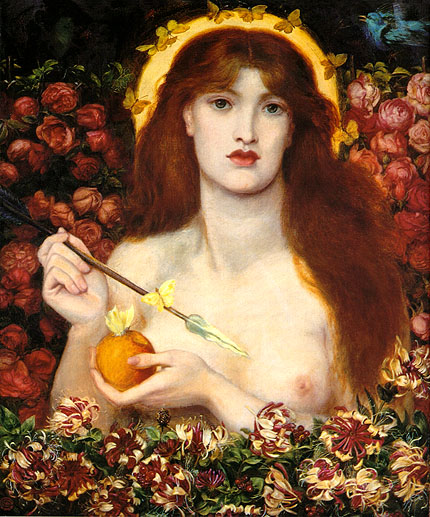
Dante Rossetti's 'Venus Verticordia'


                How does this aid comprehension of female sexuality? Aside from the fact that very few authors were women, men barely acknowledged female sexual desires; and when they did it was generally in regard to a fallen woman, prostitute, or voluptuary. That doesn’t exactly allow women to take the reins in their own sexuality, which encompasses their consent, fantasies, wants, and needs. The Victorian era was a very confusing time to be a woman; how and when were they to know their value? Was it when they chose the chaste love, or when their clothes were hitting the floor to pose for a painting? The dichotomy of the era kills me, which I believe is due in part to women’s shifting place in society. With the industrialization of England, middle class women were now able to work in factories for a salary. This differed from more home-spun ways of making a living, in which a woman would sit at a loom and weave, or sew. The Lady of Shalott describes the shift well, the Lady herself has no impetus to do anything other than sit at a loom and weave tapestries all day. That is until she sees Lancelot riding toward Camelot, in that moment her curse is thrust upon her. In a feminist view, the Lady’s curse concerns women’s issues with their place in society and their sexuality. 

              Obviously, women’s subjugation played a huge role in their institutionalization and the advent of “widow’s disease” or hysteria. Hysteria bloomed and was considered by medical professionals to be strictly a feminine issue (etymologically speaking, the Greek hysteria literally means her illness deriving from the word for uterus). Treatment for hysteria ranged from the invention of the vibrator to high powered “water massages” aimed at the vagina. It was first thought of as “wandering womb syndrome” and resulted in “female semen” needing to be expelled from the womb with regular climax and intercourse. But at the same time, women were supposed to be the “angel of the house” and in charge of the hearth, home and rearing of children. Clearly, the Victorian era is a far cry from our enlightened age of, “I want a lady in the street, but a freak in the sheets.”

                There is no resolution to be found within Victorian literature, no defined women’s lib movement empowering vaginas and sexual appetites everywhere. The same problem these women were facing still persists today, although in differing ways. Looking at it in black and white, sexuality is a fluid and ever changing force and most people fail to comprehend the affect it has on their person. It is in my belief that to truly understand our own sexuality (whoa there, I’m speaking as a fellow lady now) men must first attempt to understand their own. Which clearly they were not ready to do in the Victorian era! There was far too much riding on social propriety and reputation for them to even consider the prospect that their wives might have sexual desires of their own or that marrying someone does not make them your property. In closing, the various works, paintings, and essays discussed helped me to analyze and synthesize the greater theme of women’s sexuality in varying types of media. 

Bibliography:


Wolff, Cynthia Griffin. “The Radcliffean Gothic Novel: A Form for Feminine Sexuality.”Eighteenth Century Literature. 9:3 (1979): 98-113. Online: Proquest. May 1 2013.

 Lee, Elizabeth. "The Femme Fatale As Object." The Victorian Web. (1997). Online. Victorianweb. May 3 2013.


Monday, April 22, 2013

Kipling, The Coward

This epitaph struck me in a most unusual way, and I believe that is due to a number of things. It's concise, only two lines and one sentence. It feels like an instant, or just a moment in time when it is read. The punctuation at the end symbolizing a single gun shot. These two lines fill me with a dread that shakes my bones. For as much as I love history, there is no beauty in it for want of war. The Great War lasted four years (1914 to 1918) and the citizens of the British Empire thought that their boys would be home by Christmastime. This war was a struggle for primacy between England and Germany, and it cost them both at least nine million lives. Their methods were archaic by today's standards: mustard gas, rifles, pistols, barbed wire, early explosive tactics, and horses. These men were ill equipped for such a war between nations and they were terrified  If they thought of death, which they often did, they prayed that a bullet would kill them cleanly because the alternative was indescribable, unbearable pain and likely death in the hospital.

But if you were a coward? You could pretend to light a cigarette and hold your lighter above the trench, hoping that a German saw the flame and would shoot you through the hand. You would be taken to the hospital to recover and not called back for action. That is, if you weren't caught. The alternative was being shot for cowardice, and letting your family grapple with Her Majesty's military for information. They want to believe that you died valiantly and unafraid, but the truth is you didn't. You couldn't face death willingly so your Captain and Lieutenant took you out of the trenches, blindfolded you, and forced death upon you. After all, God's Chosen Daughter (England) has no use for cowards like you.

Note: I have more feelings than I would like about the Great War. I blame history and Downton Abbey.

Thursday, April 11, 2013

(Il)logic and (Non)sense

When reading Alice in Wonderland and The Importance of Being Earnest, I couldn't help but notice the authors differing uses of logic and sense. As in, they concocted their tales with the exact opposite: illogic and nonsense. Understandably, the Victorian audience was not expecting such convoloted uses of rhetoric, so for the vast majority of the audience, they failed to comprehend that the authors were in fact, making fun of their lifestyles. In Carroll's experience, even good old Queen Vic failed to grasp that he was challenging the monarchy and its indiscretion by making of light it, as exemplified by the Queen of Hearts. Wilde, however, chose to dissect society in general; this included the marriage market, gender, homosexuality, the education system, etc.

Carroll uses nonsense to enhance the reader's understanding of common sense, as opposed to what the government deems sensical (i.e., the trial scene in the novel). He uses Alice  to guide his reader's through the novel with their various prejudices while ever so slowly dismantling them. Wilde uses his characters (in all their exaggerations) as various archetypes for his audience to sympathize with. Their various turns of character and their snap decisions cause the audience to peer into a mirror of themselves. Whether they choose to recognize this, or not is completely up to their discretion.

Wednesday, March 27, 2013

Dismantling the Patriarchy sans merci


After reading both versions of Keats' work, I find that I prefer the draft version over his published one. 'Knight-at-arms' just strikes a chord better than 'wight'. Plus, I find that the imagery comes easier in the first version of the poem. Incorporating the titles, 'sans merci' means without pity whereas 'sans mercy' is simply without mercy. Both phrases are ripe with meaning, but 'without pity' just appeals to me greater than 'without mercy'. In the draft, Keats has the knight-at-arms making the woman a flower crown, bracelets, and a zone before he is consumed by her power; it's his attempt to quell a wild woman and confine her to fit his needs within the patriarchy. Historically, the Victorian era bound women both by its social propriety and its fashions. I like that this woman with 'wild eyes', is still able to entrance a seemingly misogynistic man after his attempts to ensnare her.  It shows her command of faculties and refusal to give up her personal power, or agency. I find it both captivating and terrifying, but in the best sort of way; as if I too, are under this faery queen's spell. It reminds me of my favorite archetype in literature: disciples that love their god too much. For there is nothing crueler than being loved by something divine made flesh and blood.

Wednesday, March 6, 2013

Keats and Negative Capability

The thing that I love about Keats' poetry is its negative compatibility. Negative compatibility is the ability to contemplate the world without the desire to try and reconcile contradictory aspects or to fit it into closed rational symbols. This is something that Keats' discussed in many of his letters with the second wave of Romantics (usually in regard to Shakespeare). But this theme is also seen in his own poetry. For our purposes, When I Have Fears is the best example of negative compatibility.

The narrator of the poem admits that he has fears of death, and that he will never have the opportunity to fully live. But, he still takes comfort in the "night's starr'd face", beauty within his "fair creature of an hour", and "unreflecting love." It is key, however, that the narrator does not try to rectify his fears; he does not attempt to reconcile contradictory aspects such as love and death and beauty into neat little boxes. He merely accepts his fate, the fate of humanity, which is to die just as surely as you have lived. For if there is one thing that we know, it's that whomever is born must also die. I feel that the couplet is the epitome of being human,
"Of the wide world I stand alone, and think,
Till Love and Fame to nothingness do sink."


Wednesday, February 20, 2013

Feminist Problems

Radcliffe's Romance of the Forest isn't necessarily my cup of tea. But that's probably due to the lack of a "strong" heroine. Adeline is described as small in comparison to her surroundings, taken in by the La Motte's, and doesn't appear to have a whole lot to say. I suppose my dislike of her is slightly my fault, because as a reader I know that I tend to sympathize with characters who have a strong backbone and gumption. I just feel that Adeline really doesn't have a whole lot to offer and is simply a vehicle to get things to happen.

Which, in  a sense I'm glad that there is a female protagonist here. We're experiencing the actions in the story through a feminine scope, as opposed to the predominant male scope. That shows some sort of progress, not Jane Austen's kind of progress; but, I'll take it. (Which is the statement of any woman, ever. Even with the advent of one Elizabeth Bennet.)

Tuesday, February 5, 2013

Southey's Abolitionist Poetry

In "The Sailor who had Served in the Slave-Trade" Southey regales his with the tale of an nonconsensual (in terms of the slavery) sailor who had worked the slave trade. The preface to the poem provides grounding in Southey's following stanzas; merely by stating that this poor bloke was found wailing in a cow house when a minister chanced upon him, essentially a very Christian, "Be wary and take heed of this poor sailor's woes, or else it might happen to you as well!" I always find prefaces in poems bewildering... This preface, I find equal parts amusing and perplexing. Amusing, due to its concise nature in its telling and perplexing as to why Southey felt it necessary to include it. The sailor's story was one of agony, but was it presented "without the slightest addition or alteration?" I think not; a sailor (unless inebriated) does not wail in a cow house and then tell a minister the horrors he's seen in a rhyme scheme. Was Southey attempting to give credence to his work because he hadn't experience the slave trade himself, or was he attempting to gain a wider audience with this "factual" account? Probably both.

Wednesday, January 23, 2013

Walpole and Shakespeare

While Walpole shows a great command of Gothic literature with the use of ghosts, floating objects, and misplaced and misguided passion; I couldn't help but notice multiple ties with his work and that of Shakespeare's Hamlet. Hamlet, much like Manfred, has a great grief upon losing his father at the beginning of the play. Both of these deaths appear to be similar in nature, but in Manfred's case his son was merely killed in a strange turn of events and not murdered. While both deaths are unnatural, I believe Manfred's son gets the short end of the stick with the "helmet that fell from the heavens." There are also great parallel's between the female characters of these works; most notably with Manfred's wife and Hamlet's mother. Each of these women appear to be solely guided by their husband's will, and not that of their own. Hippolita, while loving her Lord husband greatly and truly, bends to his every will. Even if it ends with his divorcing of her, which contrasts with her devout religious beliefs. Hamlet's mother merely marries her brother-in-law after and seemingly short mourning period for her dearly departed husband. Both texts rely heavily on the use of phantasms and spirits, with the odd shot of misplaced passion and the death of a fair maiden. Of course, Shakespeare originated various tropes with which author's use greatly to their advantage. My thought was that the works were much too similar for my taste.